Sony BRAVIA 2M2 (K-43S22BM2) Review: The 43-Inch 4K Smart TV That Punches Above Its Price
Sony’s BRAVIA 2M2 series landed in India in 2025 as the brand’s most accessible 4K lineup, and the 43-inch variant — model number K-43S22BM2 — is the one most Indian living rooms are sizing up. It carries an MRP of ₹54,900, though street prices hover between ₹38,000 and ₹48,000 depending on sales cycles and retailer. That puts it squarely in the premium-budget segment where Samsung’s Crystal 4K series, LG’s UQ series, and TCL’s C-series all compete aggressively.
The question every buyer asks at this price point: is the Sony badge and processing engine worth the premium over cheaper alternatives? After digging through every specification sheet, hands-on review, and buyer experience available, here’s the full picture — no marketing fluff, just what matters when this TV actually sits in your living room.
What’s in the Box and First Impressions
Sony ships the K-43S22BM2 with the TV panel, a T-shape blade stand (screw-in, minimalist), the new Premium Eco Remote with dedicated hotkeys for YouTube, Netflix, and Crunchyroll, an AC power cord, and the standard warranty card and user manual. The TV weighs approximately 11 kg with the stand attached and about 7.8 kg without it — light enough that a single person can manage wall mounting, though the VESA pattern is 200 × 200 mm, so make sure your wall-mount bracket matches.
The design language Sony went with here is what they call “floating design” — the screen sits nearly flush to the edges with minimal bezels, and the T-shape stand gives the impression the panel is hovering just above your entertainment unit. It is not the bezel-less marvel of Sony’s OLEDs, but for a mid-range LED TV, the screen-to-body ratio is generous and the dark metallic finish blends into most room aesthetics without calling attention to itself. The overall build feels solid, and Sony’s X-Protection PRO certification adds a layer of assurance — this TV is rated to handle dust, humidity, power surges, and lightning strikes, all of which matter in Indian conditions where voltage fluctuations are common.
Display & Picture Quality: The X1 Processor Difference
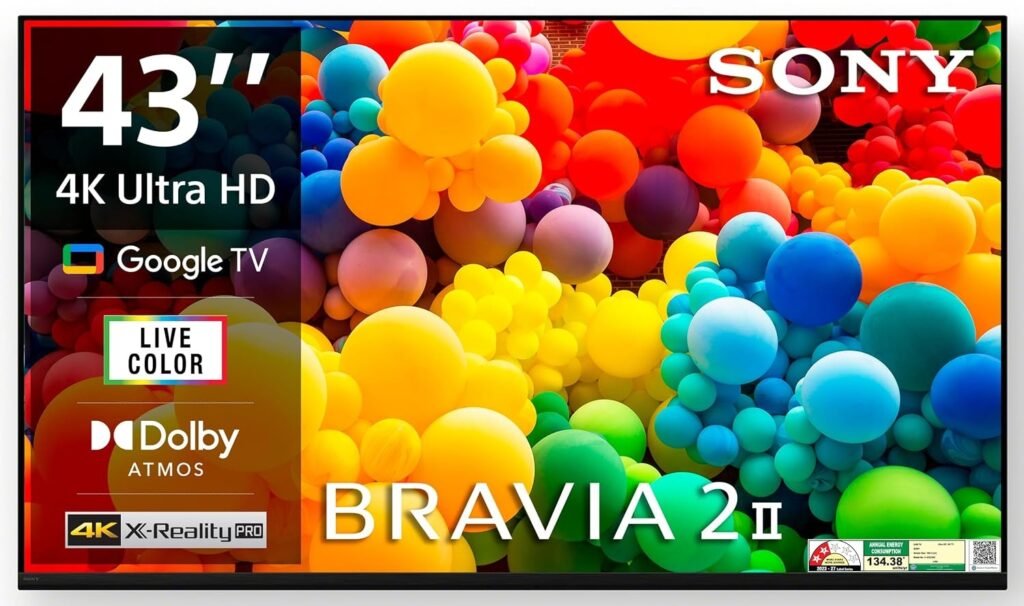
This is where the Sony BRAVIA 2M2 justifies most of its price premium. The 43-inch panel is a Direct LED with 4K Ultra HD resolution (3840 × 2160) and a 60 Hz refresh rate — standard for the segment. On paper, those specs don’t scream “premium.” But the secret weapon is the 4K Processor X1, Sony’s in-house image-processing engine that has been trickling down from their flagship TVs for years.
4K X-Reality PRO Upscaling — The Real-World Difference
Let’s be honest about how most Indian households use a 4K TV. You’re not watching 4K Blu-rays every night. You’re streaming compressed content on YouTube and Hotstar, watching DTH set-top-box feeds that max out at 1080i, and occasionally firing up Netflix or Prime Video at 4K when the Wi-Fi cooperates. In this real-world mix, the X1 processor’s 4K X-Reality PRO upscaling is the single most impactful feature Sony brings to the table.
The processor analyzes every frame in real time, comparing it against a reference database of textures and patterns, then reconstructs the image to fill in the missing detail — sharpening edges, reducing compression artifacts, and cleaning up noise. The result: even a 720p YouTube video or a cricket match on a standard DTH connection looks noticeably cleaner and more detailed on this Sony than it does on competing TVs at similar prices. Multiple buyer reviews on ShopAtSC and Reddit’s r/ApplianceGuideIndia specifically call out the upscaling as the reason they chose Sony over Samsung or LG. One Reddit user’s long-term review put it bluntly: “Excellent picture processing and upscaling — natural colors and clean image quality.”
Colour Performance & HDR
The K-43S22BM2 supports HDR10 and HLG (Hybrid Log-Gamma), the two HDR formats that cover virtually all streaming and broadcast content in India. It does not support Dolby Vision — that’s reserved for the higher-end Bravia 5 and above. For most buyers, this is not a dealbreaker. HDR10 is the baseline standard for Netflix, Prime Video, and YouTube HDR, and HLG is the broadcast HDR format used by some DTH providers.
Sony layers several colour-enhancement technologies on top of the panel: Live Colour Technology expands the colour gamut for vibrant-but-natural saturation; Dynamic Contrast Enhancer adjusts contrast frame by frame rather than applying a blanket setting; and the overall colour tuning leans toward accuracy rather than oversaturation. If you’ve seen competitor TVs that make skin tones look orange or grass look radioactive green, you’ll appreciate Sony’s restraint here. Colours feel natural and balanced, which matters more the longer you watch.
The Trade-offs — Brightness, Contrast, and Reflections
No review is honest without the weaknesses. The K-43S22BM2 uses a Direct LED backlight without local dimming, which means blacks look more like dark grey in a dim room. RTINGS’ lab test of the BRAVIA 2 II series confirms “awful contrast” and “poor HDR brightness” — in a pitch-dark room, you’ll notice the backlight glow on letterbox bars during movies. This is the trade-off at this price point, and it is not unique to Sony — every Direct LED TV without local dimming in this segment has the same limitation. Samsung’s Crystal 4K and LG’s UQ series fare similarly here.
In a brightly lit room, the panel’s reflectiveness becomes more noticeable. The Times of India review noted that glossy-screen reflections in a sunlit room caused eye strain during extended viewing. If your TV faces a window with direct sunlight, budget for good curtains — this applies to most glossy-panel TVs, not just this Sony.
MotionFlow XR 100 handles fast-motion scenes — cricket, football, action films — by interpolating frames to reduce judder and blur. It works well for sports and movies, though purists may prefer to turn it off for cinematic content to avoid the “soap opera effect.” The 60 Hz panel means this is not a 120 Hz gaming display, but for television and casual gaming, the motion processing does its job adequately.
Audio: 20W That Surprises
TV speakers rarely impress, but Sony has put genuine thought into the K-43S22BM2’s audio system. The 20W output (10W + 10W) Open Baffle Speakers support Dolby Atmos, Dolby Audio, DTS Digital Surround, and DTS:X — a comprehensive codec support list that covers every major streaming and Blu-ray audio format.
The Open Baffle design means the speaker drivers fire directly into the room rather than being enclosed in a tiny sealed box, which gives the sound a wider, less “tinny” character. Dolby Atmos processing creates a virtual height and surround effect — it is not going to replace a dedicated soundbar, but for a built-in TV speaker system at this price, the clarity and separation are above average.
The Times of India review tested the audio with Pirates of the Caribbean: Salazar’s Revenge and Top Gun: Maverick, noting that “chain sounds, water effects, characters’ dialogues, and the musical score are all individually identifiable, without any one element drowning out another.” That level of audio separation is unusual for a 20W built-in system. For 5.1-channel content, the volume takes a slight dip but the spatial quality improves noticeably. If you primarily watch dialogue-heavy content — news, talk shows, sitcoms — the built-in speakers are more than sufficient. For movie nights, pairing a soundbar via HDMI eARC or Bluetooth is straightforward.
Smart TV Experience: Google TV Done Right
Sony has fully committed to Google TV as its smart platform, and the K-43S22BM2 runs a clean, responsive implementation. This is not the sluggish, ad-riddled smart TV experience some brands ship — the X1 processor keeps the interface snappy, and Sony adds minimal bloat on top of stock Google TV.
What You Get
- Google TV home screen with personalized recommendations drawn from your watch history across apps
- Google Assistant built into the remote for voice search — say “find sci-fi movies” or “what’s the weather” and it works
- Google Cast (Chromecast Built-in) — cast from any Android, iOS, or Chrome browser without installing anything extra
- Apple AirPlay 2 and HomeKit — stream directly from iPhone, iPad, or Mac; integrate with Apple smart home setups
- Works with Alexa — pair with any Alexa device for hands-free voice control of power, volume, and channels
- Watchlist — save movies and shows from your phone via Google search and they appear on the TV
- Kids Profile — a dedicated profile with fun avatars, themes, parental controls including watch timers and bedtimes
- Sony Pictures Core (formerly BRAVIA Core) — Sony’s exclusive streaming service with IMAX Enhanced and DTS audio titles at up to 80 Mbps bitrate; the highest streaming quality available on any TV platform
App support covers over 10,000 apps via the Google Play Store — Netflix, Prime Video, Disney+ Hotstar, YouTube, Apple TV, Zee5, Sony LIV, JioCinema, and every other Indian streaming service you can name. The Premium Eco Remote comes with dedicated hotkeys for YouTube, Netflix, and Crunchyroll, plus a built-in microphone for Google Assistant.
Connectivity: Ports and Wireless
The K-43S22BM2 is well-equipped for a 43-inch TV in this price bracket:
| Port Type | Count | Notes |
|---|---|---|
| HDMI | 4 | At least one supports eARC/ALLM (HDMI 2.1 compatible) |
| USB | 2 (Side) | For external drives, USB playback |
| Wi-Fi | Wi-Fi 6 (802.11) | 2.4 GHz and 5 GHz dual-band |
| Bluetooth | Yes (A2DP) | For headphones, speakers, keyboards |
| Ethernet | Yes | Wired LAN for stable streaming |
| Headphone Out | No | Use Bluetooth or HDMI/optical instead |
The 4 HDMI ports are generous — most 43-inch TVs in this segment ship with only 3. You can simultaneously connect a set-top box, a gaming console, a streaming stick or Blu-ray player, and still have a spare port. The HDMI port supporting eARC (Enhanced Audio Return Channel) lets you pass lossless Dolby Atmos audio to a compatible soundbar or AV receiver without compression. ALLM (Auto Low Latency Mode) automatically detects when you fire up a game and switches the TV to low-latency mode without manual intervention.
Gaming Performance: Casual Ready, Not Hardcore
Let’s set expectations clearly. The K-43S22BM2 is not a gaming-first TV. It supports 4K at 60 Hz, ALLM for low-latency switching, and eARC for audio passthrough — but it lacks HDMI 2.1 full-bandwidth ports, Variable Refresh Rate (VRR), and 120 Hz support. RTINGS labels it “a poor gaming TV” for these omissions, and they are correct if you measure against purpose-built gaming displays.
However, for the target audience — a family buying a primary living-room TV — this configuration is perfectly adequate. Casual gaming on a PlayStation 5 or Xbox Series X works fine at 4K 60 Hz; the ALLM feature means the TV automatically drops into game mode when you power on the console, keeping input lag low enough that most people won’t notice any delay. The picture quality benefits of the X1 processor (upscaling, colour accuracy, motion handling) carry over into gaming. If you’re playing story-driven single-player games — God of War, Spider-Man, Red Dead Redemption — this TV delivers a great experience. If you’re a competitive FPS gamer who needs 120 Hz and VRR, look at Sony’s BRAVIA 5 or higher, or a dedicated gaming monitor.
Power Consumption & Efficiency
The K-43S22BM2 carries a 2-Star energy rating from BEE, with an annual energy consumption of approximately 134.38 kWh and an on-mode power draw of 104 W. In real terms, assuming 5-6 hours of daily use, expect roughly ₹50-70 added to your monthly electricity bill depending on your state’s per-unit rate. Not negligible, but consistent with other 43-inch 4K LED TVs in this class. The Eco Dashboard in Google TV lets you monitor and optimize energy settings — you can adjust brightness, set auto-off timers, and see real-time power-saving data.
Price, Value & Competition
| Retailer / Platform | Approximate Price |
|---|---|
| MRP (Sony Official) | ₹54,900 |
| ShopAtSC (Sony’s own retail) | ₹47,990 |
| Amazon India | ~₹38,490 – ₹44,990 |
| Reliance Digital | ~₹42,000 – ₹47,000 |
At the ₹38,000-48,000 street price, the K-43S22BM2 competes directly with:
- Samsung Crystal 4K Vivid (43″) — typically ₹3,000-7,000 cheaper; slightly punchier contrast out of the box but weaker upscaling and less natural colours
- LG UQ Series (43″) — often ₹8,000-13,000 cheaper; solid value but upscaling and motion processing fall noticeably behind Sony
- TCL C-series / P-series (43″) — QLED options available at similar or lower prices with better brightness and Dolby Vision support, but weaker upscaling, build quality, and long-term reliability reputation
- Hisense U6 / Tornado (43″) — strong spec-to-price ratio with local dimming on some models; software and processing consistency trail Sony
A Reddit post from r/shubz summarized the competition well: “Sony’s 2M2 series TVs command a premium compared to Samsung or LG. LG are often ₹13,000 cheaper. [Sony does a] good job in producing accurate colors and skin tones.” That’s the core trade-off: you pay more for Sony’s processing, upscaling, colour accuracy, and build quality — and less for the raw spec sheet.
Who Should Buy the Sony BRAVIA 2M2 K-43S22BM2?
Buy this if:
- You watch a lot of DTH/cable content and need excellent upscaling (this is where Sony wins decisively)
- Colour accuracy and natural skin tones matter more than peak brightness
- You want a clean Google TV experience without heavy-handed manufacturer bloatware
- Build quality and long-term reliability are priorities
- You own a PlayStation and want seamless ALLM/eARC integration
- You watch in a moderately lit room (not pitch-dark home theatre)
Look elsewhere if:
- You need deep blacks and high contrast for dark-room movie watching (consider a QLED or VA-panel TV)
- You want Dolby Vision HDR support
- Competitive 120 Hz gaming with VRR is non-negotiable
- Budget is tight — Samsung and LG offer comparable 43-inch 4K sets for less
Final Verdict
The Sony BRAVIA 2M2 K-43S22BM2 does not win on a spec-sheet comparison. Its 60 Hz panel, Direct LED backlight without local dimming, and lack of Dolby Vision put it behind several cheaper competitors on paper. But televisions are experienced, not read off a spreadsheet. What the X1 processor does with that panel — the upscaling, the colour tuning, the motion handling, the overall image cohesion — gives this TV a “sum greater than parts” quality that most buyers appreciate the moment they see it next to a competitor’s display.
For the Indian household that watches a mix of DTH, OTT streaming, and occasional gaming, and values a natural, fatigue-free picture over flashy oversaturation, the K-43S22BM2 is one of the strongest 43-inch 4K options in its price band. The premium over Samsung and LG is real, but so is the picture-quality return on that premium — especially on the non-4K content that still makes up most of what Indians watch every day.