OLED vs QLED Buying Guide: Which TV Should You Buy in India in 2026?
Confused between OLED vs QLED? This India buying guide compares blacks, brightness, gaming, burn-in, and price in INR to help you pick the best 55-inch TV.
Friends, welcome to USNMix. If you are planning to buy a new 43-inch, 50-inch, 55-inch or 65-inch Smart TV in India this year, you will get stuck on this one question — OLED or QLED?
Both look stunning in the showroom. Both claim 4K, Dolby Vision, 120Hz, and gaming features. But in your home, with your light, your viewing distance, and your budget, they behave very differently.
This OLED vs QLED buying guide breaks it down in simple language — how the technology works, real picture differences, price in India, burn-in truth, gaming performance, and exactly who should buy which. No jargon, no brand hype.
Buy: Samsung QA55S85HAELXL OLED 4K Vision AI 2026 Smart TV
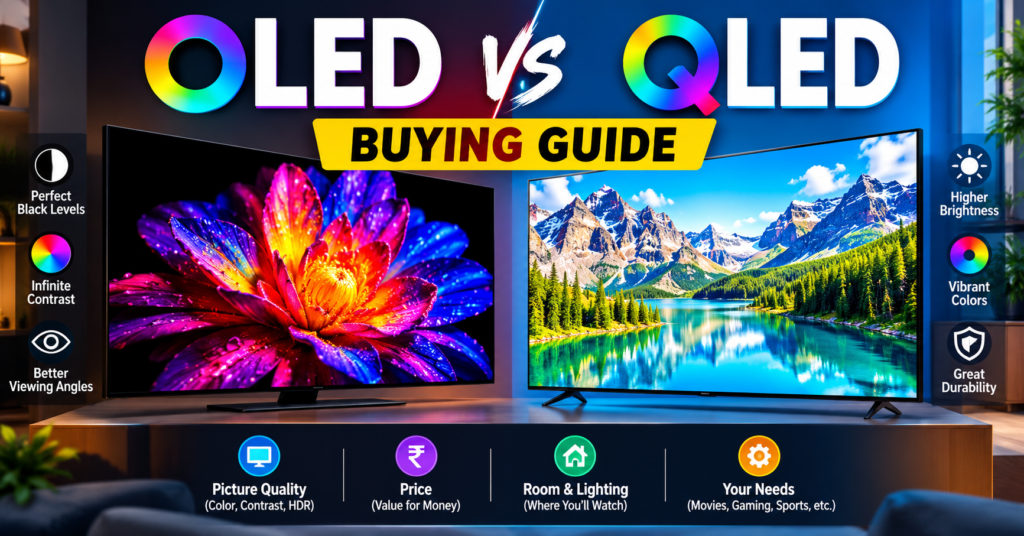
Quick Verdict: OLED vs QLED in 30 Seconds
Buy OLED if you watch movies at night, love cinema-like deep blacks, watch from wide angles with family, and your budget is Rs. 95,000 and above for 55-inch.
Buy QLED if your living room is bright with lots of sunlight, you watch news, sports, and daily soaps for long hours, you want a bigger 55-65 inch screen under Rs. 70,000, and you want zero worry about burn-in.
Still confused? Read on. The details matter.
1. What is OLED TV? Explained Simply
OLED means Organic Light Emitting Diode. Forget backlight.
In an OLED TV, every single pixel produces its own light. There are 8.3 million pixels in a 4K OLED, and each one can turn ON and OFF individually.
That is why when a scene is black, that pixel is completely off. You get perfect black, infinite contrast, and no light bleeding around subtitles or stars in a night sky.
In India, OLED TVs are mainly sold by LG (C3, C4, C5, B4 series), Sony (Bravia A80L, A95L QD-OLED), and Philips. LG Display makes almost all OLED panels in the world.
Strengths of OLED: Perfect blacks, best contrast, widest viewing angles, ultra-thin design, fastest response time for gaming and movies, most natural colours for cinema.
Weaknesses of OLED: Peak brightness is lower than premium QLED, price is high, and there is a small risk of permanent burn-in if the same static logo stays on screen for thousands of hours.
2. What is QLED TV? Explained Simply
QLED means Quantum-dot LED. It is NOT self-lit like OLED.
A QLED is still an LED LCD TV at heart, with a backlight behind the screen. Samsung adds a Quantum Dot layer to make colours brighter and more vibrant. Think of it as a super-charged LED TV.
Samsung is the biggest QLED seller in India, followed by TCL, Hisense, Acer, and Vu in budget segments. Sony and LG also sell similar tech under names like Bravia Triluminos and QNED.
Strengths of QLED: Much brighter picture, excellent for bright Indian living rooms, no risk of burn-in, bigger screen sizes for less money, great for daily news, cricket, and kids’ cartoons.
Weaknesses of QLED: Blacks look greyish dark blue in a dark room, contrast is limited, viewing angles are narrower on budget VA panels, and some blooming around bright objects on dark background.
Note: Samsung’s premium Neo QLED uses Mini LED backlight with thousands of dimming zones. It is much closer to OLED in blacks, but still not perfect. We will cover it below.
3. OLED vs QLED: Head-to-Head Comparison Table
This is the core of this OLED vs QLED buying guide. Save this table:
| Feature | OLED | QLED (Standard + Neo QLED) |
|---|---|---|
| How it works | Self-lit pixels, no backlight | LED backlight + Quantum Dot layer |
| Black levels | Perfect black, pixel turns off | Dark grey, backlight always on |
| Contrast | Infinite | Good to Very Good (Neo QLED best) |
| Brightness | 700-1000 nits (QD-OLED up to 2000) | 800-3000+ nits, wins in bright rooms |
| Viewing angle | Excellent, no colour fade till 170-degrees | Average, fades after 30-40 degrees on VA panels |
| Colour in dark room | Most accurate, cinematic | Slightly oversaturated |
| Colour in bright room | Gets washed out | Punchy and visible, clear winner |
| Gaming (PS5, Xbox) | 0.1ms response, 120Hz, G-Sync, best motion | 120Hz on premium models, good but more blur |
| Burn-in risk | Low but real with static logos 8+ hrs daily | Zero risk |
| Lifespan | 7-10 years normal use | 8-10+ years, better for heavy daily use |
| Power consumption | Lower for dark scenes, higher for bright sports | More consistent |
| Price in India 55-inch | Rs. 1,05,000 – Rs. 1,65,000 | Rs. 45,000 – Rs. 95,000 (Neo QLED Rs. 90k+) |
4. Picture Quality: Where You Will Actually See the Difference
Blacks and Movies
Play a space movie or a dark web series like Sacred Games on both TVs side-by-side in a dark room. The difference is instant.
On OLED, night looks like night. On QLED, night looks like very dark grey. If you are a movie lover who watches at night with lights off, OLED feels like a PVR cinema at home.
For daily Indian TV — Anupamaa, news debates, Tarak Mehta, IPL in the afternoon — you will not notice this advantage much.
Brightness and Indian Living Rooms
This is where most Indian buyers make a mistake.
Most Indian living rooms have large windows, white walls, and tube lights. Here, brightness matters more than perfect blacks.
A good QLED pushes 1500-2000 nits easily. An entry OLED struggles around 700-800 nits. In a bright room at 2 PM, the QLED will look punchy and clear, while the OLED will look dim and reflective.
Rule from USNMix testing: Bright room = QLED. Light-controlled bedroom / home theatre = OLED.
Viewing Angles for Family
In India, 4-6 people often watch together — some sitting sideways on a sofa or on the floor.
OLED maintains colour and brightness even from the side. Budget QLEDs with VA panels lose contrast fast when you move sideways. If you have a wide hall, check this in the store by walking sideways.
If you buy QLED, look for IPS-ADS panels or wide viewing angle layer for better angles, though blacks get slightly weaker.
Also Read: Sony vs Samsung 55 Inch TV Battle (2026): OLED vs Neo QLED
5. Gaming: PS5, Xbox Series X, and PC
For gamers, this OLED vs QLED buying guide has a clear winner: OLED.
Why? Three reasons:
- Response time: OLED is 0.1ms vs 5-8ms on QLED. No ghosting in BGMI, COD, or EA FC.
- HDMI 2.1 + 120Hz + VRR: LG C4/C5 and Sony A80L give you 4K 120Hz, ALLM, FreeSync, and G-Sync on all ports. Budget QLEDs often give only 60Hz or 120Hz on one port.
- Input lag: Both are low now, but OLED motion clarity is visibly smoother.
But one caution: If you play the same game with static HUD for 6-8 hours daily, or keep NDTV / Aaj Tak ticker on all day, QLED / Neo QLED is safer for long-term panel health.
Our pick: Best TV for gaming in India right now is 55-inch LG C4 OLED if budget allows. If budget is under 70k, go for TCL C755 QD-Mini LED or Samsung Q80D QLED with 120Hz.
6. The Burn-In Truth: Should Indians Worry?
Burn-in means a faint ghost image of a static logo stays permanently. It was a big issue in 2018-2020 OLEDs.
In 2024-2026 panels, LG and Sony have pixel shift, logo dimming, and panel refresh. For normal mixed use (2-4 hours movies, OTT, sports), risk is very low.
Risk becomes real only if: You run the same news channel 10 hours daily at high brightness, or you use it as a PC monitor with taskbar 8 hours daily.
For shops, offices, and heavy news watchers, buy QLED with zero worries. For home cinema use, don’t fear OLED.
USNMix tip: Keep OLED Light at 70-80 for SDR daily use, turn on Pixel Shift, and run Pixel Cleaning once a month. Panel will easily last 7+ years.
7. QD-OLED and Mini LED: The New Wildcards in 2026
You will now see two more terms in stores. Don’t get confused:
QD-OLED (Samsung S90D, S95D, Sony A95L): Combines OLED perfect blacks with Quantum Dots for higher brightness (up to 2000 nits). Best of both worlds, but Rs. 1,60,000+ for 55-inch in India. Buy only if money is no object.
Mini LED / Neo QLED (Samsung QN90D, TCL C755/C855, Hisense U7N): Uses thousands of tiny LEDs for backlight. Blacks are 80% as good as OLED, but brightness is insane and no burn-in. Price Rs. 75,000-1,10,000 for 55-inch. This is the sweet spot for many Indian buyers in 2026.
If you want OLED-like contrast without burn-in fear, Mini LED is your middle path.
Buy: LG OLED55C6PLA Smart webOS OLED TV
8. Price in India: Real Street Prices (2026 Diwali / Online Sale)
Prices change during Flipkart Big Billion Days and Amazon Great Indian Festival. Typical range:
55-inch QLED: TCL, Hisense, Vu, Acer – Rs. 42,999 – Rs. 59,999 Samsung QLED Q70D/Q80D – Rs. 68,000 – Rs. 85,000 Samsung Neo QLED / TCL Mini LED – Rs. 89,000 – Rs. 1,15,000
55-inch OLED: LG B4 – Rs. 1,04,990 – Rs. 1,15,000 LG C4 / C5 – Rs. 1,29,000 – Rs. 1,59,000 Sony A80L – Rs. 1,45,000 – Rs. 1,75,000
65-inch: Add roughly Rs. 40,000-60,000 to above.
Value logic: A 65-inch QLED often costs less than a 55-inch OLED. If size matters for your hall (10-12 feet viewing distance), a 65-inch QLED gives more theatre feel than a smaller OLED.
9. So Which Should YOU Buy? 5 Buyer Profiles
1. Movie + OTT lover, bedroom, lights off: Buy OLED. LG C4 55-inch. You will never go back.
2. Bright hall, family of 5, daily soaps + cricket + news: Buy QLED or Neo QLED 65-inch. Samsung Q80D or TCL C755.
3. Hardcore PS5 gamer: Buy OLED with HDMI 2.1 120Hz. LG C-series is the gold standard.
4. Budget under Rs. 60,000, want 55-inch big screen: Forget entry OLED (not available). Buy TCL / Hisense QLED. Excellent value.
5. Office, shop display, 10+ hours daily static content: Buy QLED only. Zero burn-in tension.
Also Read: How to Turn Any TV Into a Smart Hub
10. USNMix Buying Checklist Before You Pay
- Measure viewing distance: 6-8 feet = 50-55 inch, 9-11 feet = 65 inch.
- Check your room light at 2 PM. Bright? Lean QLED.
- Confirm 120Hz native panel, not motion rate. Must for sports/gaming.
- Confirm HDMI 2.1 ports count (need 2 for PS5 + soundbar).
- Confirm Dolby Vision + HDR10+ both supported (LG misses HDR10+, Samsung misses Dolby Vision – important for Netflix vs Prime).
- Sound: Budget 10k extra for soundbar. Thin TVs = thin sound.
- Warranty: Take 3-year extended panel warranty for OLED. Ask for burn-in coverage in writing.
Frequently Asked Questions
Is OLED better than QLED for eyes? Both are safe. OLED flicker is lower in dark rooms, QLED is easier to watch in bright rooms without straining. Keep 8-10 feet distance and use Eye Care mode at night.
Which lasts longer, OLED or QLED? QLED lasts slightly longer for heavy 10-hour daily news/static use. For normal 3-5 hour mixed OTT use, both last 7-10 years easily.
Is LG OLED better than Samsung QLED? Different strengths. LG OLED wins in dark room cinema. Samsung Neo QLED wins in brightness and no burn-in. Compare LG C5 vs Samsung QN90D, not base QLED.
Can I buy OLED if my room is bright? You can, but you will need thick curtains. Otherwise you pay 1.3 lakh and still get washed picture in daylight. For bright halls, Mini LED QLED is smarter.
What about Sony? Sony A80L OLED uses LG panel with better processing for movies. Sony X75L / X90L are LED options. Sony costs 15-20% more but picture processing is superb for Indian cable content.
Final Verdict From USNMix
There is no universal winner in this OLED vs QLED buying guide. There is only the right TV for your room.
If you want that wow, cinema-at-home feeling and mostly watch at night — stretch and get OLED. You will thank yourself every movie night.
If you want a bright, tension-free, big-screen family TV for all-day use under Rs. 80,000 — get a good QLED or Mini LED. It is 90% of the fun at 60% of the price.
Friends, hope you enjoyed this guide and thanks for watching — I mean, reading! If you plan to buy, check the product links in our YouTube description box, comment your room size and budget in the comment section, and subscribe to USNMix for full unboxings with price, full specifications, and technical details.
Want a personal pick? Tell us: 1) Room – bright or dark, 2) Size – 43/50/55/65, 3) Budget in INR, 4) Main use – movies, cricket, or gaming. We’ll reply with 2 exact models.
Buy: Samsung QA65QEF1AULXL Vision AI 4K Ultra HD Smart QLED TV